
Today is Saturday, July 4th, 2026
It’s a new day in paradise!
Published since 2008, !TFAM is a bi-weekly lifeline that unites readers and
asks them to ensure the Tuskegee Airmen’s legacy of excellence. !TFAM
provides an inside view into the lives of Tuskegee Airmen and the people
they influence.
Today Harry T. Stewart would have been 102 years old.

Here is a collection of newspaper articles, pictures, an obit, and an interview from The Wall
Street Journal.

Harry Stewart, Tuskegee Airman, VBCMagazine, Extract, Pages 12-
13 SUMMER 2024 (PDF file)
file:///C:/Users/lsimps1/Downloads/Harry%20Stewart,%20Tuskegee%2
0Airman,%20VBCMagazine,%20Extract,%20Pages%2012-
13%20%20Summer%202024.pdf
Story about Top Gun
This next item/email came from Margaret Brown, a friend of
Tuskegee Airmen and Tuskegee Airmen Scholarship Foundation.
I know I talk about the Tuskegee Airmen too much but this was on
the African and Black History Facebook
Facebook story African and Black History posting
Here is a little history for individuals who are fans of the movies Top
Gun and Top Gun: Maverick.
The first Top Gun competition was held in 1949.
The Caucasian pilots competed with the latest state of art aircraft,
while the African-American pilots were forced to compete with the
much older, obsolete planes.
After 3 days of competition, the Tuskegee Airmen team of : Captain
Alva Temple, 1st Lieutenant Harry Stewart, 1st Lieutenant James
Harvey, and 1st Lieutenant Halbert Alexander (alternate) were
announced the winners.
There was dead silence in the room.
Not one of their (hypocritical) colleagues applauded this
accomplishment.
The victory was swept under the rug, and the trophy was not seen by
the public for 55 years.
Introducing the real Top Guns

A Tuskegee Airman Turns 95
America isn’t perfect, but it was and still is worth fighting for.
By
Harry Stewart
July 2, 2019 7:15 pm ET

Harry Stewart Jr. among other graduates of Tuskegee Flying School in
Alabama, 1944. U.S. Air Force via Harry Stewart Jr.
I was born on Independence Day 95 years ago. On June 27, 1944, I
graduated from Tuskegee Army Flying School, established in
Alabama shortly before America’s entry into World War II to train
young African-American men as Army combat pilots.
My journey to the flight line started in my high-school library in
the New York City borough of Queens. I came across a magazine
article about the first all-black flying combat unit, the 99th Pursuit
Squadron. I decided right then that when I turned 18 the squadron
was where I wanted to serve. These black flyers had glamour, polish,
prestige. The Army Air Forces accepted me even though I had no
high-school diploma. The country needed pilots, I was gung-ho, and
I had passed the battery of written tests.
The train ride down South was eye-opening for a teenager who’d
never traveled far from New York. When the train crossed the Mason-
Dixon Line, the conductor came by and pointed at me: “Move to
the colored car.” It was disconcerting, but I saw it as an unavoidable
hurdle to earning my wings. I swallowed hard and kept going.
At Tuskegee Army Airfield, the sky filled with silvery planes
emblazoned with the Army Air Forces star-in-circle insignia. The big-
barreled trainers emitted a raspy cacophony from their radial
engines and fast-turning propellers. You felt you were part of
something big, something magnificent. You weren’t just learning to
fly; you were serving your country, and you were going to fight.
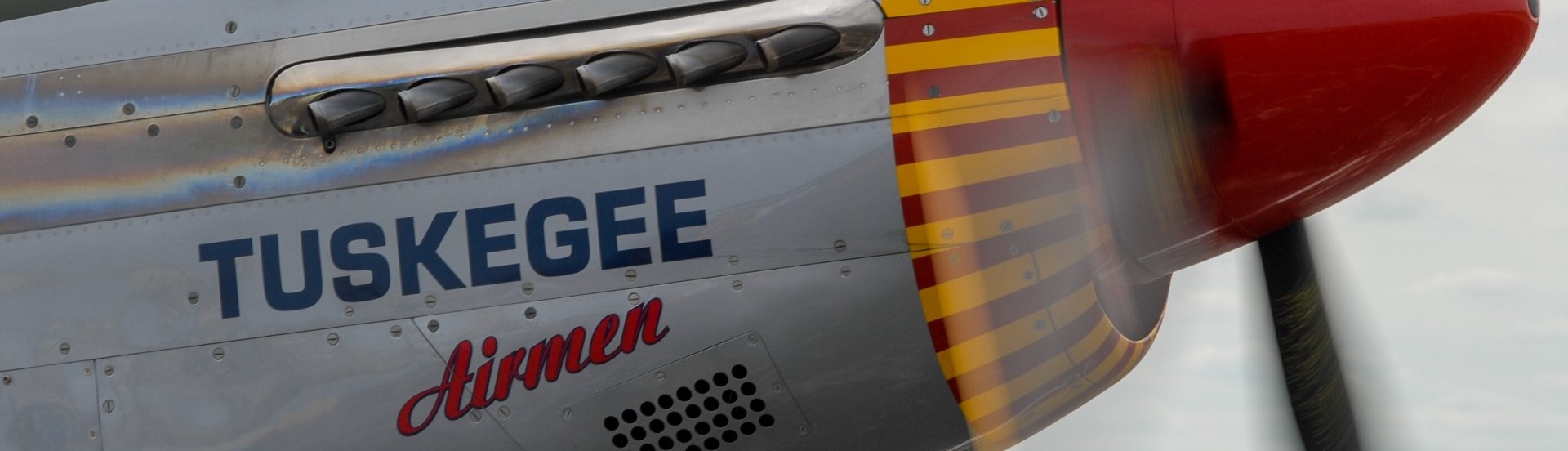
At the controls of P-51 Mustangs, I flew 43 combat missions with the
332nd Fighter Group, known as the Red Tails. Our commander was
the legendary Benjamin O. Davis Jr., who had endured four years of
the silent treatment from white cadets at West Point but nevertheless
managed to graduate 35th out of a class of 276. At our mission
briefings, he implored us, “Gentlemen, stay with the bombers!” His
convictions were encapsulated in his statement: “The privileges of
being an American belong to those brave enough to fight for them.”
On Easter Sunday 1945, I shot down three long-nosed Focke-Wulf Fw
190s, the best piston fighters in the Luftwaffe inventory. That action
resulted in my receiving the Distinguished Flying Cross. I was thankful
that my country had given me the opportunity to fly and fight, and
all these years later I am proud that I contributed to the cause. We
called it winning the Double V, victory against totalitarianism abroad
and institutional racism at home.
July 4 is my birthday, but I celebrate my country’s birthday too.
America was not perfect in the 1940s and is not perfect today, yet I
fought for it then and would do so again.
Harry Stewart Jr. Dies at 100; One of Last Tuskegee Airmen to See
Combat – The New York Times
February 6, 2025
Harry Stewart Jr. Dies at 100; One of Last Tuskegee Airmen to See
Combat
His boyhood dream to be an adventurous pilot was fulfilled thanks to
World War II. But, as a civilian, racial prejudice kept him out of the
cockpit.
Listen to this article · 7:54 min Learn more
Harry Stewart Jr. in 1944. During World War II he flew 43 missions —
almost one every other day — between 1944 and
1945.Credit…via Stewart Family
By Alex Traub
Feb. 5, 2025
Harry Stewart Jr., a decorated former combat pilot who was among
the last surviving Tuskegee Airmen, the all-Black unit of the Army Air
Forces in World War II, and who, after being denied a civilian career
in aviation, made a late-life return to the skies, died on Sunday at his
home in Bloomfield Hills, Mich. He was 100.
The death was confirmed by Philip Handleman, who collaborated
with Mr. Stewart in writing his biography, “Soaring to Glory: A
Tuskegee Airman’s Firsthand Account of World War II” (2019).
In his 2019 biography (which he wrote with Philip Handleman),
Mr. Stewart recounted his life and career as a Tuskegee pilot and
beyond.Credit…Regnery History
Mr. Stewart was one of a tiny handful of still-living Tuskegee pilots
who saw combat in the war. He flew 43 missions — almost one every
other day — from late winter 1944 into the spring of 1945.
On one mission, to attack a Luftwaffe base in Germany,
Lieutenant Stewart and six other American pilots were baited into a
dogfight with at least 16 German fighter planes. Firing his machine
guns and performing risky aerial maneuvers, he downed three
enemy aircraft in succession, fending off a potential rout.
He was awarded the Distinguished Flying Cross, cited for having
“gallantly engaged, fought and defeated the enemy” with no
regard for his personal safety.
That’s all for now.
love you madly!
L. Sunnye Simpson
Editor and publisher